








Is It Hair Shedding, Breakage, or Thinning?
Here’s How to Tell the Difference
August 27, 2026
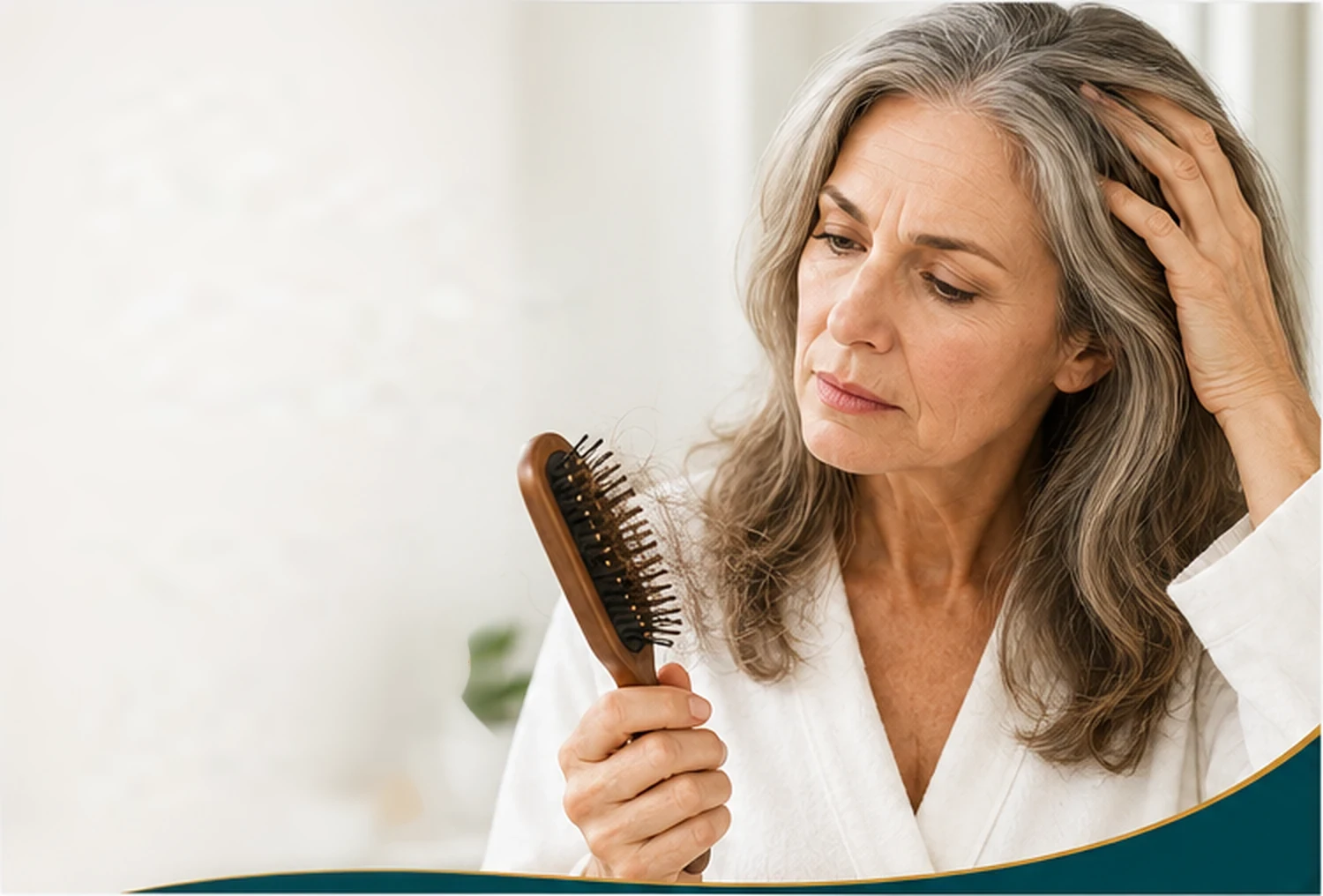
You notice more hair than usual in the shower drain.
Then you start seeing strands on your sweater. A few more in your brush. Maybe your ponytail doesn’t feel quite as thick as it once did.
And suddenly you’re wondering:
“Am I losing my hair?”
It’s an unsettling question, but before you assume the worst, there’s something important to understand:
Hair shedding, hair breakage, and hair thinning aren’t necessarily the same thing.
They can look remarkably similar at first — and it’s possible to experience more than one at the same time…
But what’s actually happening to your hair can be quite different.
So, instead of simply counting the hairs in your shower drain, let’s look at the clues your hair may be giving you.
Hair SheddingWhen the Whole Strand Falls Out
First, some shedding is completely normal.
Your hair naturally moves through a cycle of growth, transition, rest, and eventually shedding. When one hair finishes its cycle, it can fall out so the follicle can begin the process again.
The important question isn’t simply “Am I shedding hair?”
It’s:
“Has my shedding noticeably changed?”
Signs You May Be Experiencing Increased Shedding
Look for:
- More full-length strands in your shower or brush
- Hair collecting on your pillow or clothing
- A noticeable increase compared with what’s normal for you
- Strands that appear to have fallen from the root rather than snapped midway
Increased shedding can sometimes follow changes in the body, including periods of significant stress, illness, hormonal shifts, nutritional changes, and certain medications.
And here’s an important distinction:
Seeing more hair come out doesn’t necessarily mean your follicles have permanently stopped producing hair.
Sometimes the issue is that more hairs than usual have entered the shedding portion of the growth cycle at around the same time.
That’s very different from the next problem.
Hair BreakageWhen the Strand Snaps
Take a closer look at the hairs you’re finding around your bathroom.
Are they all roughly the same length as your hair?
Or are you seeing lots of shorter pieces?
If you’re finding short strands of different lengths, you may be dealing with breakage.
Instead of the entire hair releasing from the follicle, part of the hair shaft has snapped.
Signs of Hair Breakage
You may notice:
- Short hairs of varying lengths
- Increased frizz and flyaways
- Dry or rough-feeling hair
- Ends that appear thin or uneven
- Hair that seems to stop getting longer
- Strands that snap easily when manipulated
Heat styling, chemical processing, tight hairstyles, aggressive brushing, friction, and environmental damage can all contribute to weakened strands.
And aging hair may require some extra attention.
Over time, changes in the hair fiber can make strands feel finer, drier, or more fragile. That means protecting the hair you already have becomes increasingly important.
Try This Simple Test
The next time you find hairs in your sink or brush, don’t immediately throw them away.
Look at their length.
A collection of full-length strands suggests something very different from dozens of little broken pieces.
Hair ThinningWhen You’re Losing Overall Density
This one can be more difficult to notice because it often happens gradually.
You may not suddenly find a huge clump of hair in your shower.
Instead, one day you look in the mirror and realize your part seems a little wider…
Your ponytail doesn’t feel as substantial…
Or you can see more of your scalp under the bright lights in your bathroom.
Common Signs of Thinning Hair
Watch for:
- A gradually widening part
- Increased scalp visibility
- Less volume around the crown
- A smaller-feeling ponytail
- Finer hairs growing in certain areas
- Hair that doesn’t seem to return to its previous density
One process that can contribute to this appearance is known as follicular miniaturization.
Simply put, a follicle begins producing progressively finer, shorter hairs. Hair may still be growing — but each new strand can be less substantial than before.
Over time, the difference can become visible as a loss of overall density.
So Which One Do You Have?
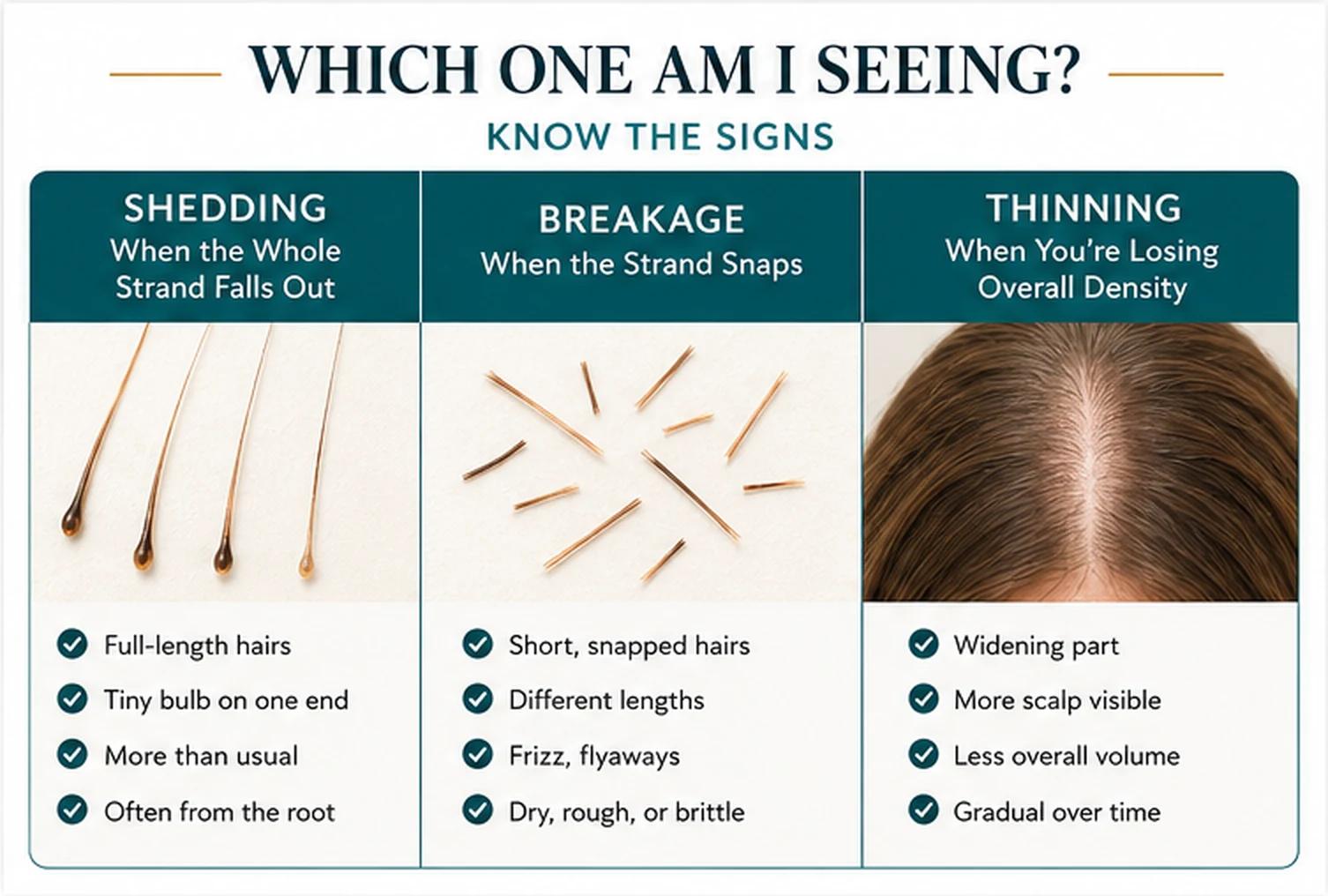
Here’s a quick cheat sheet:
| What You’re Seeing | What It May Suggest |
|---|---|
| Full-length hairs coming out | Increased shedding |
| Lots of short, snapped hairs | Breakage |
| Widening part or increasingly visible scalp | Thinning |
| Rough, brittle or uneven ends | Breakage |
| Sudden increase in the amount of hair coming out | Increased shedding |
| Gradual loss of volume over months or years | Thinning |
| Several of these signs at once | Possibly more than one issue |
And that last row is particularly important.
The Part Many Women Miss: You Can Have More Than One at Once
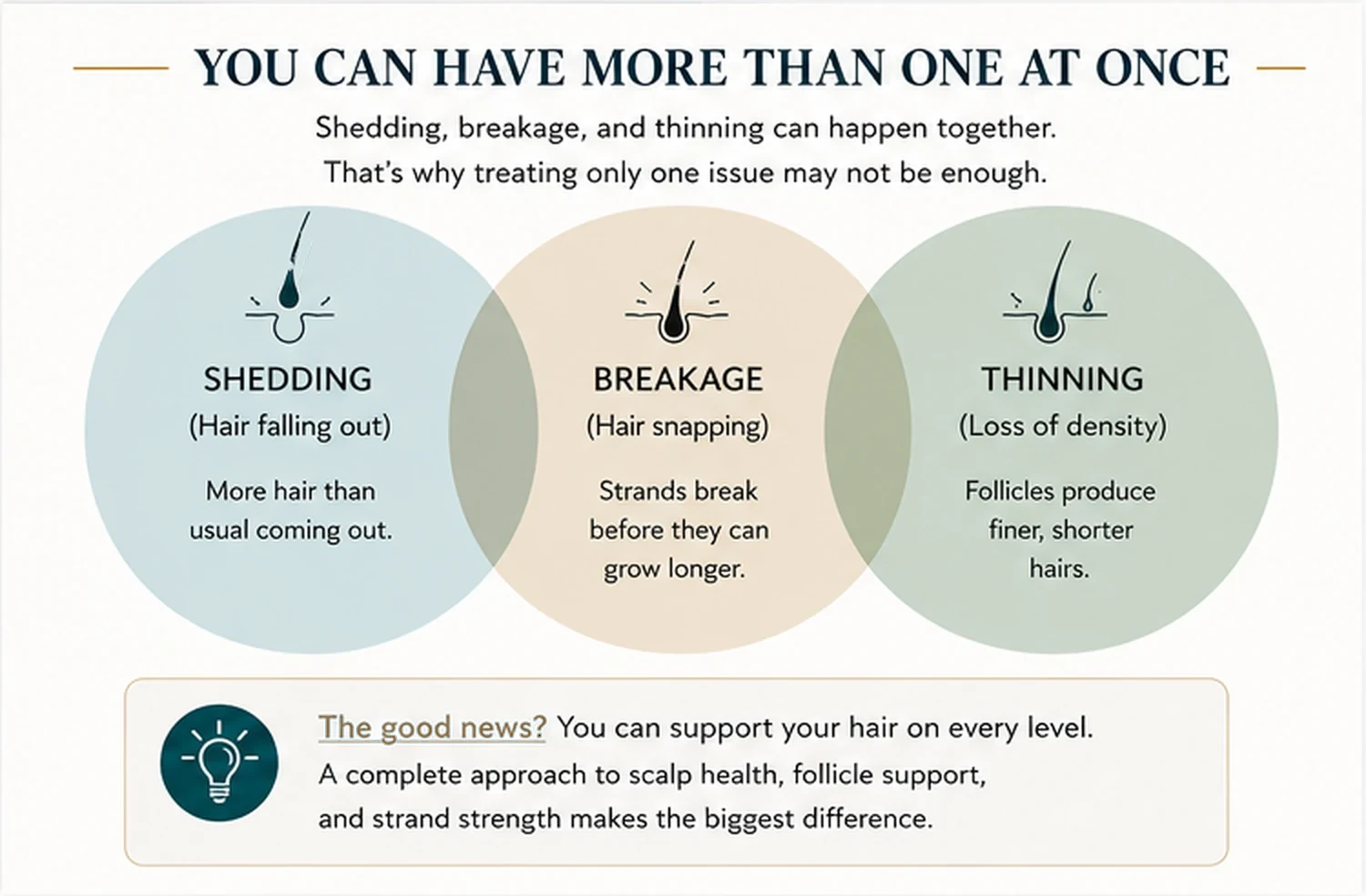
Hair doesn’t always fit neatly into one category.
For example, you could be experiencing increased shedding and have strands that have become fragile enough to break easily.
Or your follicles may gradually be producing finer-looking hair while chemical processing or frequent heat styling damages those already-delicate strands.
That can create a frustrating cycle:
The CycleLess hair appears to be growing in → the hair you have becomes more vulnerable → overall volume appears to decline even faster.
This is also why simply trying to make thinning hair look fuller doesn’t necessarily address everything that’s happening.
A volumizing styling product may create a temporary cosmetic difference.
But if you’re concerned about the long-term appearance of your hair, it makes sense to think beyond volume alone.
Think Scalp → Follicle → Strand
Instead of treating every hair concern as the same problem, consider supporting your hair at multiple levels.
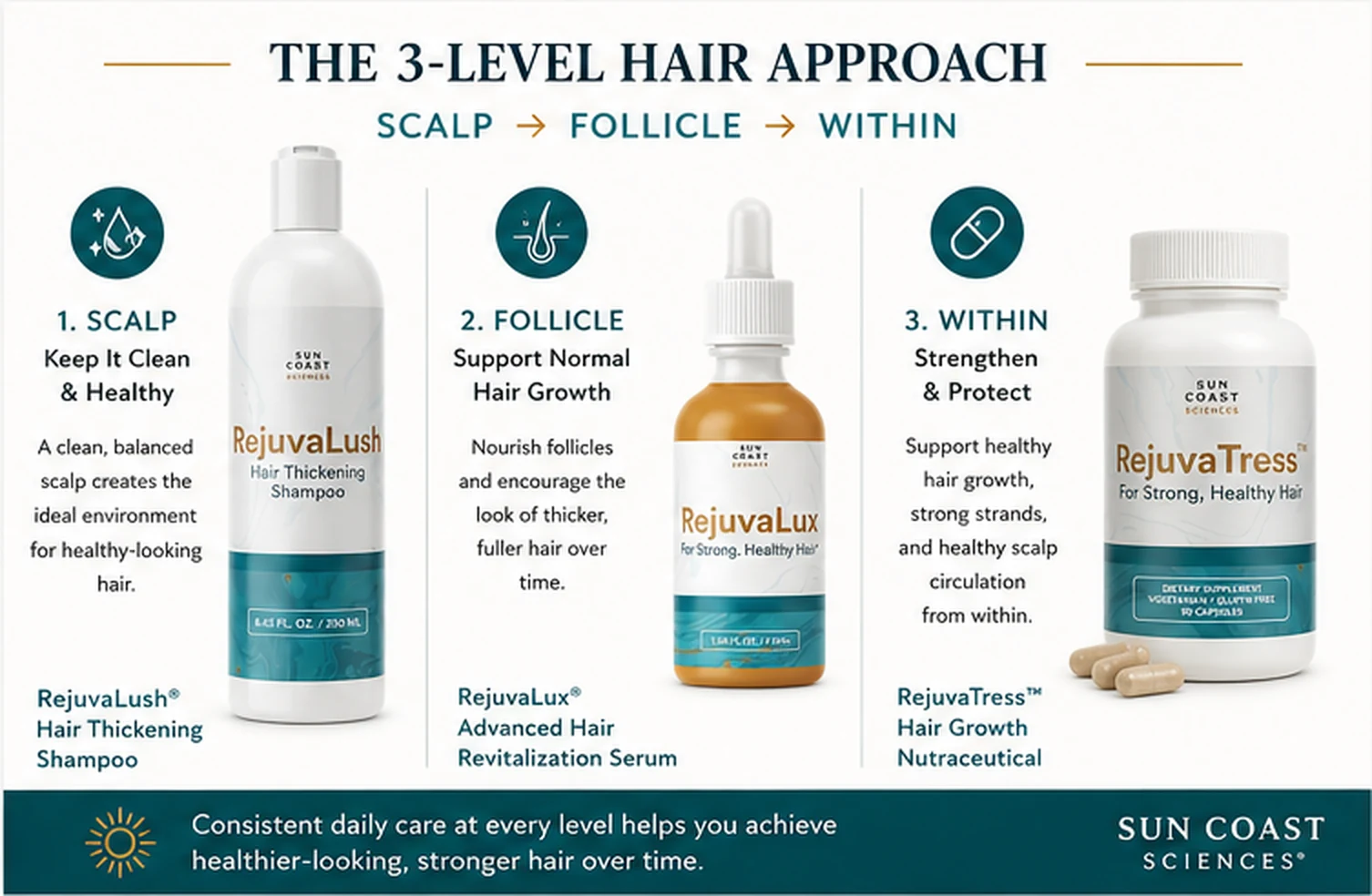
Create a Healthy Foundation
Healthy-looking hair begins at the scalp.
Regular cleansing helps remove excess oil, dead skin, and styling-product buildup that can accumulate around the scalp and hair.
This is where RejuvaLush Hair Thickening Shampoo fits into a complete routine.
Rather than being designed solely to make existing hair look more voluminous, RejuvaLush was formulated with follicle-targeting ingredients while also supporting stronger, more resilient strands.
Especially relevant if you’re noticing: fragile hair, breakage, shedding, or buildup around the scalp.
Support Your Natural Hair-Growth Cycle
If your biggest concerns are shedding, a widening part, or declining density, your routine shouldn’t stop at the hair you can already see.
The follicle beneath the scalp is where each strand begins.
RejuvaLux Advanced Hair Revitalization Serum is a daily topical formula designed specifically for women experiencing thinning, shedding, and weaker-looking hair.
It’s applied directly to the scalp, concentrating its ingredients where the hair-growth process begins.
Especially relevant if you’re noticing: increased shedding, a widening part, reduced density, or thinner-looking areas around the crown and hairline.
Support Hair From Within
Finally, don’t forget that your body needs the nutritional building blocks required to produce healthy hair.
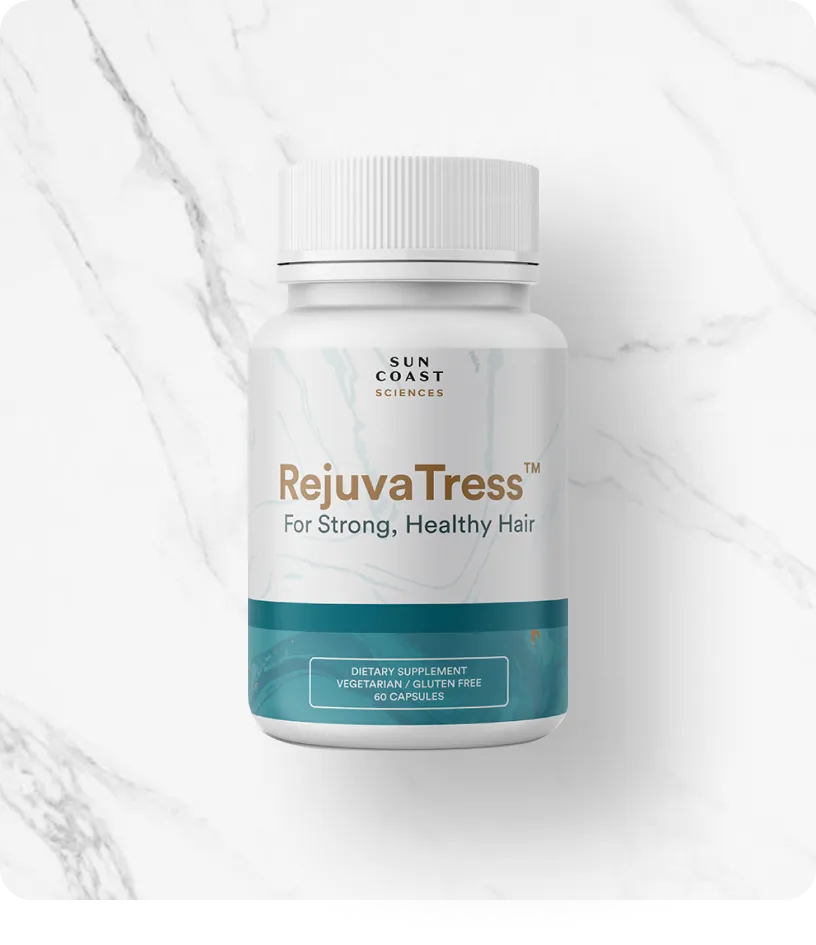
RejuvaTress Hair Growth Nutraceutical takes an inside-out approach, providing nutritional support for healthy hair growth, strong strands, and healthy scalp circulation.
This makes it a natural complement to topical scalp and hair care.
Especially relevant if you’re looking for: whole-body nutritional support as part of a more comprehensive hair routine.
Why Use All Three?
Think of it this way:
- RejuvaLush — Cleanse the scalp + support resilient strands. View RejuvaLush
- RejuvaLux — Target the scalp and follicles topically. View RejuvaLux
- RejuvaTress — Support healthy hair from within. View RejuvaTress
You don’t necessarily have to change everything about your routine overnight.
But understanding where your hair concerns may be occurring can help you make much more informed choices about what you use.
Start By Paying Attention to the Hair You’re Losing
Tonight or tomorrow morning, take just 30 seconds to examine your hair.
Look at what’s actually in your brush or shower.
Ask yourself:
Are these hairs long?
Are they short and broken?
Has the amount suddenly changed?
Does my hair feel more fragile than it used to?
Has my part gradually become wider?
You may begin noticing patterns you hadn’t seen before.
And those patterns can be far more useful than simply worrying about the number of hairs you see in the drain.
Because “hair loss” isn’t always one problem.
Understanding what your hair is telling you is the first step toward giving it the care it actually needs.
Support Your Hair at Every Level
Doctor-designed formulas for the scalp, the follicle, and from within — backed by our 365-day guarantee.


When Should You Talk to a Doctor or Dermatologist?
Gradual changes in hair can be common, particularly as we get older. But certain changes deserve professional attention.
Speak with your healthcare provider or a dermatologist if you experience sudden or significant hair loss, bald or patchy areas, scalp pain or inflammation, intense itching or scaling, or another unexplained change in your hair or scalp.
A medical professional can help determine whether an underlying health issue may be contributing to the change.
These statements have not been evaluated by the FDA. Our products are not intended to diagnose, cure, treat or prevent any disease. Results may vary from individual to individual.